

Supabase
Connect Supabase as an access review source using a personal access token so Probo can list the members of your Supabase organization.
Probo reads your Supabase organization’s members through the Supabase Management API so you can review who has access.
Prerequisites
Section titled “Prerequisites”- Probo organization administrator access
- A Supabase account with an organization role in the organization you want to review. Every organization role (Owner, Administrator, Developer and Read-Only) can list organization members. An account with access to specific projects only cannot select the organization for an Organization token. A token never has more access than the account that created it
- The Organization Slug of the organization Probo should review, which the Connect dialog asks for alongside the token. Supabase puts it in the dashboard URL while the organization is open:
supabase.com/dashboard/org/<organization-slug>
Collected Fields
Section titled “Collected Fields”| Probo field | Supabase field | Notes |
|---|---|---|
| Name | user_name | The member’s Supabase user name. There is no fallback, so a member returned without one is listed with an empty name |
email | ||
| Role | role_name | The members endpoint returns one role name per member. Supabase’s organization roles are Owner, Administrator, Developer and Read-Only. Probo trims surrounding whitespace, and a member returned without a role name is listed without one |
| Admin | role_name | Flagged as an administrator when role_name is Owner or Administrator, and not for Developer or Read-Only |
| Status | Not supported | |
| MFA | mfa_enabled | Enabled when the flag is true, disabled otherwise. Supabase returns the flag for every member |
| Last login | Not supported | |
| External ID | user_id | Stable identifier used to track the account across reviews |
| Created at | Not supported |
Step 1: Create a Personal Access Token
Section titled “Step 1: Create a Personal Access Token”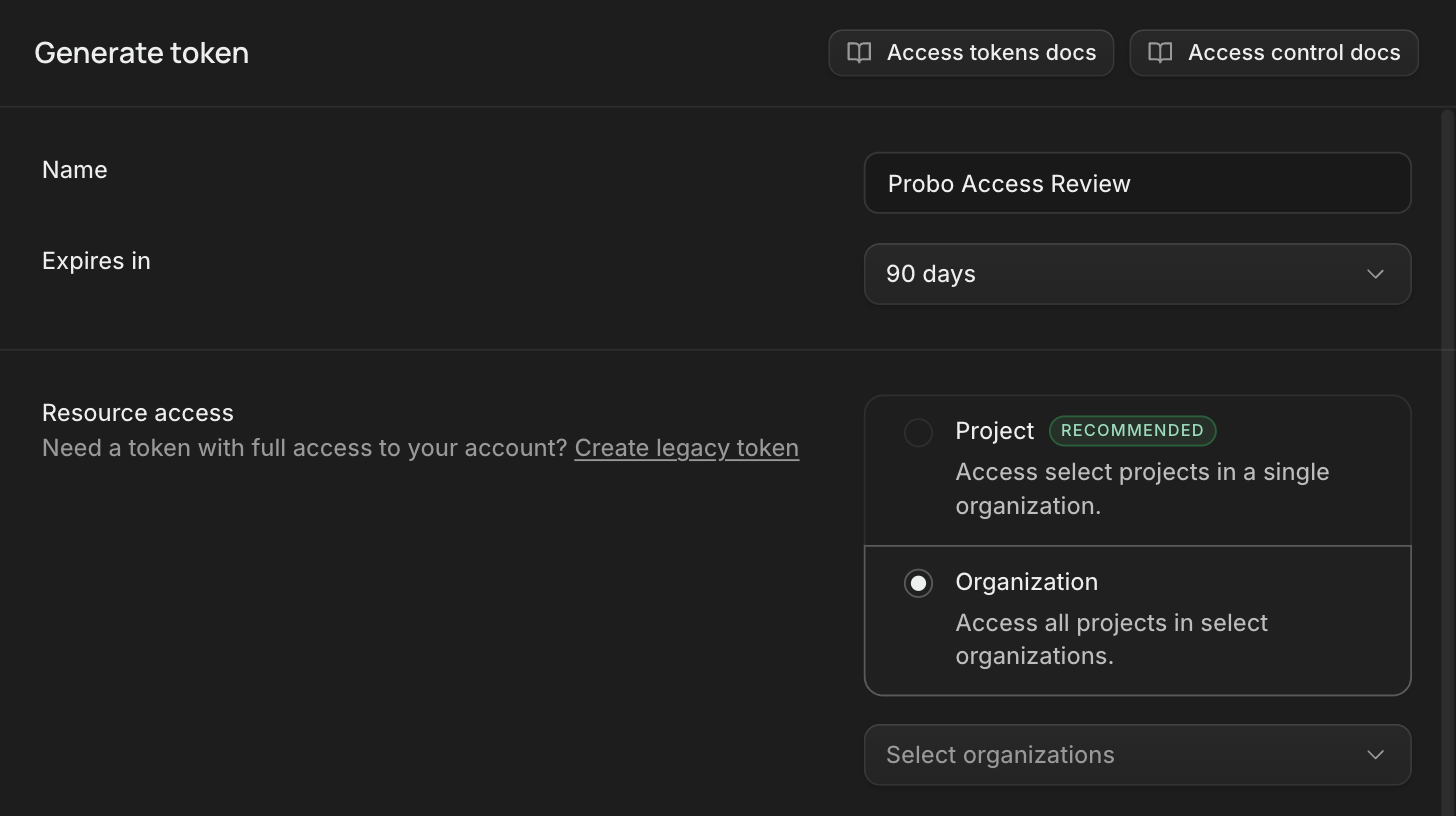
- In the Supabase dashboard, go to Account Settings > Access Tokens and click Generate new token.
- Enter a Name (e.g.
Probo Access Review) and set Expires in. The dialog defaults to 7 days, so pick 90 days or a Custom date that covers your review cycle. - Under Resource access, select Organization instead of the default Project, then choose the organization Probo should review in Select organizations.
- Under Permissions, open Account and organization and set Organization Members to Read. Probo reads nothing else, so leave the other permissions at None.
- Click Review access, then Create token. Copy the token (
sbp_…) and store it securely. Supabase shows it once and you cannot retrieve it afterwards.
Step 2: Connect in Probo
Section titled “Step 2: Connect in Probo”- In Probo, go to Access Review > Connections.
- Find Supabase, click API Key, paste the token, enter your Organization Slug, and click Connect.
When you click Connect, Probo uses the token to request that organization’s members from Supabase. If Supabase has no organization with that slug, the dialog shows an error under Organization Slug. If it accepts the token but refuses to list that organization’s members, the error appears under API Key. In both cases Probo does not save the connection. After you connect, Probo names the source after your organization slug and pulls its members into your campaigns.
Troubleshooting
Section titled “Troubleshooting”- Token rejected. The Connect dialog only accepts a key that starts with
sbp_, so a project API key is refused before it reaches Supabase. An expired or deleted personal access token is not caught when you connect: the source then shows Supabase credentials are invalid. Confirm the token is still listed under Account Settings > Access Tokens. - “This access token cannot read the members of this organization.” Shown under API Key. The token has the default Project resource access, is scoped to other organizations, or belongs to an account that is not a member of this organization. Generate a token with Organization resource access that includes the organization and Organization Members set to Read.
- “Supabase has no organization with this slug.” Open the organization in the Supabase dashboard and copy the Organization Slug from the URL:
supabase.com/dashboard/org/<organization-slug>. - Syncs worked and then stopped. The token has expired, or the account that created it has left the organization. A token has only its owner’s access, so it stops reading the organization once that person leaves. The console cannot replace the token on an existing source. Generate a new token, Delete the source in Connections, and connect Supabase again with the new token. Campaigns that already include the deleted source stop fetching it, so start a new campaign to review it again.
- Using a legacy token. A legacy token has full access to your account and shows a LEGACY badge on the Access Tokens page. Tokens created before Supabase introduced scoped tokens are legacy tokens, and so are tokens made with Create legacy token. A legacy token works, but it grants far more access than Probo needs. Prefer a token scoped as described in Step 1.